

The short version
Yes, there is something like a Moore’s Law for AI, and it is running far faster than the original. The best-known yardstick, from the research group METR, found that the length of task a leading AI can complete on its own has doubled roughly every seven months since 2019. Their January 2026 update put the recent pace at closer to every four months.
Moore’s Law described computer chips doubling in transistor count roughly every two years. On the AI yardstick, a doubling every four to seven months is between three and six times faster than that.
One caution before you read on. The measurement is narrower than “AI power”. It tracks how long a task, timed by how long a skilled person takes, an AI can finish unsupervised about half the time, and most of the tasks are software work. That is a useful signal of where things are heading, not a promise about what you can hand over tomorrow.
Where the seven-month figure comes from
The figure comes from a March 2025 paper by METR, a research non-profit that tests what frontier AI systems can do without a human steering them. The paper was called Measuring AI Ability to Complete Long Software Tasks.
Their method was simple in outline. Build a set of around 170 software and reasoning tasks, time skilled people doing each one, then set AI agents loose on the same tasks. The time a task took a person turned out to predict the AI’s success remarkably well: at the time, leading models almost always finished tasks that took a person under four minutes, and succeeded less than one time in ten on tasks that took a person over four hours.
From that they defined a “50% time horizon”: the length of task, in skilled-human time, at which a model succeeds about half the time. Plot that figure for every leading model since 2019 and it rises in a straight line on a logarithmic scale, doubling about every seven months. GPT-2 in 2019 managed tasks of a few seconds; by early 2025 the best model was managing tasks of roughly an hour.
The paper’s authors extrapolated that trend and suggested AI agents could handle tasks taking people days or weeks within the decade. That extrapolation is what turned a research finding into a headline.
What is actually being measured, and what is not
The time horizon measures the difficulty of a task, not how long the AI spends on it. A “two-hour horizon” means the model has an even chance on tasks that would take a skilled person two hours; the AI itself usually finishes faster. METR’s own FAQ spells out several things the number does not mean, and they matter for anyone running a business.
- It is mostly software work. The tasks are software engineering, machine learning and cyber-security problems. METR found similar growth rates in other fields, but with very different starting points.
- It is a coin toss, not a guarantee. The 50% figure is the headline. At 80% reliability, the kind of odds you would accept from a member of staff, the horizon is several times shorter.
- The tasks are cleaner than real work. They are self-contained, clearly specified and marked automatically. METR suggests thinking of a two-hour horizon as what a new hire or a freelancer with no prior context could do in two hours, not what your experienced office manager could.
- Messy tasks go worse. When METR scored work holistically, the way a client or a manager would, performance dropped substantially.
So “AI power doubling every seven months” is a loose translation. The accurate version is: the length of well-defined, mostly technical task that frontier AI can finish unsupervised about half the time has been doubling every four to seven months.
How it compares with Moore’s Law
Moore’s Law was never a law of nature either. In 1965 Gordon Moore, later a co-founder of Intel, observed that the number of transistors on a chip was doubling every year; in 1975 he revised that to roughly every two years. The industry then treated the forecast as a target and spent fifty years hitting it.
| Moore’s Law | AI time horizon | |
|---|---|---|
| What doubles | Transistors on a chip | Length of task an AI can finish unsupervised, at 50% reliability |
| Doubling time | About 2 years | About 7 months since 2019; about 4 months since 2023 |
| How long it has held | Roughly 1965 to the 2010s | 2019 to 2026 |
| What drove it | Shrinking manufacturing processes | Bigger models, more computing power, better training and tool use |
| Where it ran into trouble | Physical limits as transistors approached atomic scale | The test itself: METR says measurements above 16 hours are unreliable with its current tasks |
Two differences matter more than the headline speed. First, Moore’s Law measured a physical thing that anyone could count; the AI horizon depends on which tasks you choose and which people you time, so the number moves when the method does. Second, Moore’s Law was a supply-side story about what chips could do, while the time horizon is an attempt to measure usefulness directly. That makes it more relevant to a business and less precise.
What the two share is the lesson. A steady exponential looks unremarkable for years, then the last few doublings change everything. Planning as if next year’s AI will be a bit better than this year’s is the same mistake as planning for computers in 1990 by looking at 1985.
Is it still seven months?
No. The pace since 2023 is nearer four months, and the measuring stick has now run out. METR’s January 2026 update rebuilt its task suite and found the doubling time since 2023 was about 131 days; since 2024 it was under 90 days.
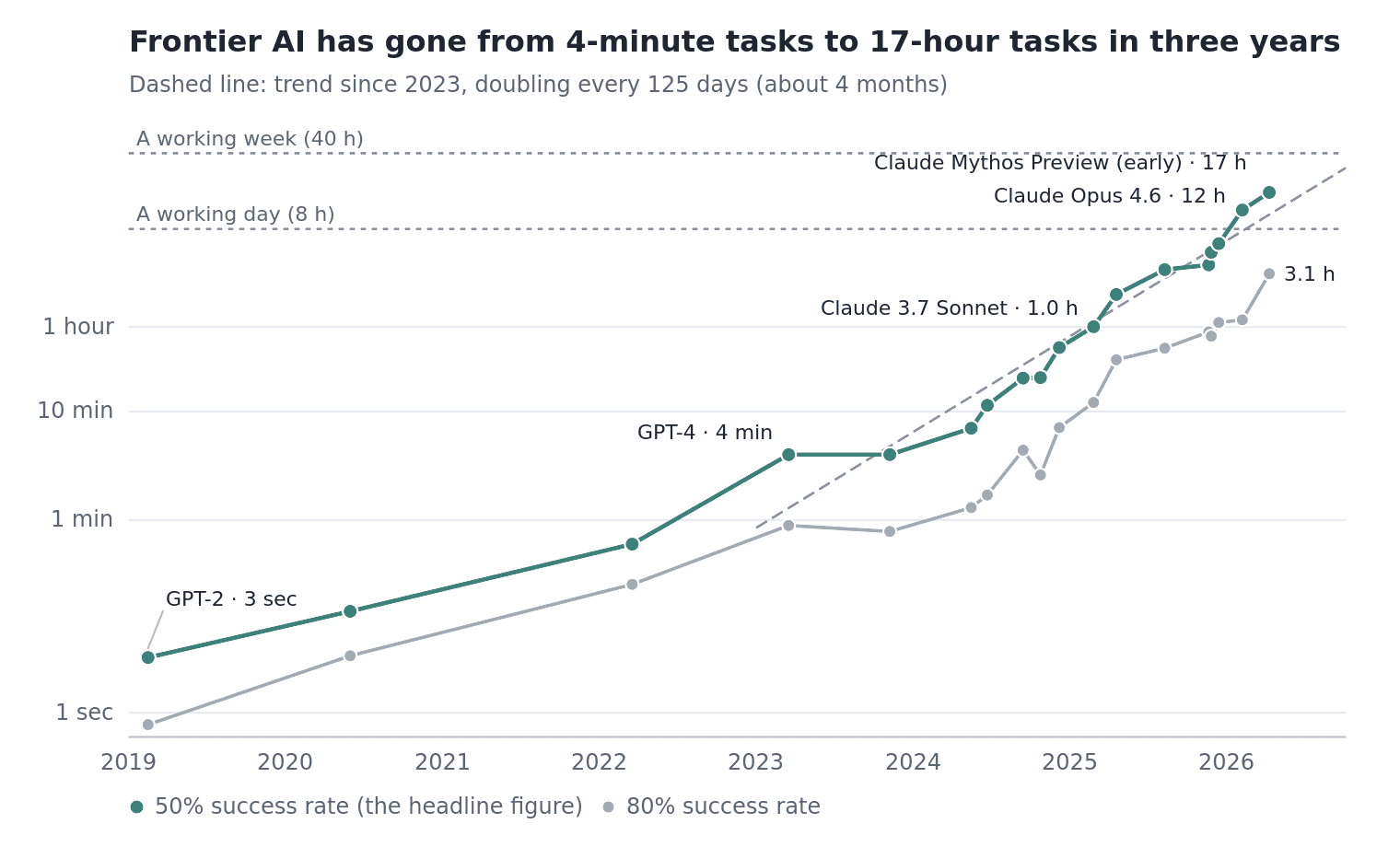
The straight line on a logarithmic scale is the exponential. Each gridline up is a tenfold increase, and the teal points have climbed five of them since GPT-2. The grey points are the same models held to an 80% success rate: the headline figure is five to ten times higher than the figure you would plan around.
The latest point is where it gets awkward. METR tested an early Claude Mythos Preview in March 2026 and could only say the horizon was at least 16 hours, with a confidence range of roughly 8 to 55 hours. Its own note says measurements above 16 hours are unreliable with the current tasks, and in September 2026 it stopped updating the page. As of October 2026, the trend held or accelerated for as long as it could be measured, and nobody has published a replacement ruler.
Why this matters for a small or medium business
The tool you tried and dismissed is not the tool that exists today. At a four-month doubling, a model released eighteen months ago is roughly twenty times short of the current one on this measure. Most of the “I tried AI and it was rubbish” verdicts in small businesses were reached on 2023 or 2024 models and never revisited.
The horizon also tells you what kind of work to hand over. In 2023 the honest answer was a paragraph: rewrite this, summarise that. By 2025 it was an hour of a contractor’s time: a page of web copy from a brief, a working spreadsheet, a first-pass SEO audit. In 2026 the headline figure is a working day or more, but the 80% figure, the one to plan around, is nearer three hours. Three hours of a competent freelancer’s work, repeated as often as you like, is still a lot of business.
Two things follow. First, the advantage no longer comes from which tool you buy; everyone has the same models. It comes from whether your business is organised so that AI can do work for you: clear briefs, written processes, somewhere for the output to go, and a person who checks it. Second, your competitors are on the same curve, so standing still is a decision too.
The reliability gap is the part not to skip. A model that is right half the time on a long task is a brilliant drafter and a dangerous finisher. Supervision is not a transitional phase you will grow out of next year; it is the job.
Three practical things to do about it
- Put a six-month review in the diary. Pick the two or three tasks you tried to hand to AI and gave up on. Note the date, the model and why it failed, and try again in six months with the current model. At the present pace that is more than one doubling; the result will often be different.
- Write the brief, not the prompt. The length of task AI can take on is now longer than most people’s instructions. A one-page brief that states the goal, the audience, what good looks like and what to leave alone is reusable, and it is what separates a usable first draft from a plausible wrong one.
- Decide who checks, and against what. For every task you delegate, name the person who reviews the output and the checklist they review it against. The 80% figure says the model will miss something on a long task; your process should assume it will, every time.
Sources and further reading
- Measuring AI Ability to Complete Long Software Tasks, METR, 19 March 2025. The original paper and the seven-month figure.
- Time Horizon 1.1, METR, 29 January 2026. The updated task suite; doubling time since 2023 of about 131 days, since 2024 under 90 days.
- Task-Completion Time Horizons of Frontier AI Models, METR, last updated 8 September 2026. The results page, the FAQ on what the number does and does not mean, and the note that measurements above 16 hours are unreliable.
- Clarifying limitations of time horizon, METR, 22 January 2026. Why doubling the horizon does not double what you can automate.
- The chart above is drawn from METR’s published results file for Time Horizon 1.1, downloaded 18 October 2026. Earlier models (GPT-2 to GPT-3.5) carry over from the original 2025 measurements, as METR’s own trend line does.