



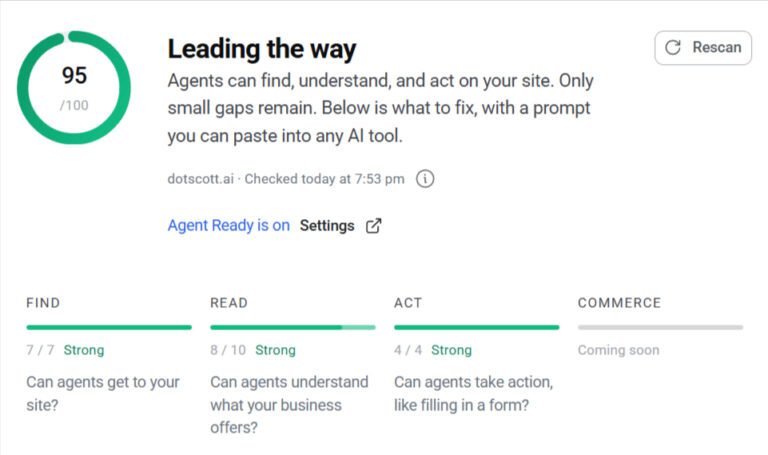








AI visibility and agent readiness: why your website needs both
More and more of your customers now ask an AI before they ask Google. Whether your business appears in the answer depends on two things: AI visibility and agent readiness. With Elementor 4.4, released on 9 November 2026, a free tool for the second one is now built into the software behind millions of WordPress websites, including the ones we build.
Here’s what both terms mean, why they matter to a small business, and what the new Agent Ready feature does about it.
What is AI visibility?
AI visibility is how often, and how accurately, AI tools such as ChatGPT, Claude, Gemini and Perplexity mention your business when someone asks a question you could answer.
It’s the AI-era cousin of ranking on Google, with one big difference. A search engine gives people a list of links to choose from. An AI gives them one answer, and usually names only a handful of businesses. You’re either in that answer or you aren’t.
Ask an AI “who can fix a boiler in Brentwood this week?” and it won’t show ten blue links. It will name two or three firms and explain why. AI visibility is about being one of them, and being described correctly.
What is agent readiness?
Agent readiness is how easily AI software can find your website, read it and do something useful on it.
When someone asks an AI to compare prices, check an opening time or find a supplier, the AI often sends a piece of software to visit websites on that person’s behalf. These are called AI agents. They never see your design. They read the code underneath, and if that code is cluttered, blocked or unclear, they misread it or move on to a competitor’s site.
A site that’s agent ready gets three things right:
| Area | The question an agent is asking | What helps |
|---|---|---|
| Find | Can I get to this site and work out what’s on it? | A sitemap, sensible bot rules, a short guide for AI called llms.txt |
| Read | Can I understand what this business offers? | Clean text, clear headings, labelled business details |
| Act | Can I do something for the person who sent me? | Search tools, properly labelled buttons and forms |
How the two fit together
Agent readiness is the foundation. AI visibility is the result you’re after.
If an AI can’t read your site, it has nothing reliable to say about you, so it says nothing, or repeats something out of date from elsewhere. Getting the technical side right doesn’t guarantee a recommendation, though. That still depends on what any good marketing depends on: clear content, real expertise, reviews and other sites talking about you.
Think of agent readiness as making sure the shop door opens. It won’t sell anything on its own, but nothing gets sold while it’s stuck.
Why this matters now
Three things have changed in the last year or so:
- Automated visitors now outnumber people. Cloudflare figures quoted by Elementor show that in June 2026 bots made about 57% of requests for web pages, against about 43% from people.
- People are getting answers without visiting. When an AI answers the question directly, fewer people click through. Being named in the answer is the new way of being found.
- Agents are starting to act, not just read. Booking, enquiring and comparing on someone’s behalf is where this is heading. The sites agents can use will get that business.
For a local business, this is an opportunity as much as a threat. Most small business websites haven’t done any of this yet, so the ones that do stand out.
Elementor’s new Agent Ready feature
Until now, making a site agent ready meant a list of technical jobs spread across different plugins and files. Elementor 4.4 pulls them into one place: a new Agent Ready page in the Elementor menu of your WordPress dashboard. It’s free, and everything is switched off until you choose to turn it on.
It has two parts.
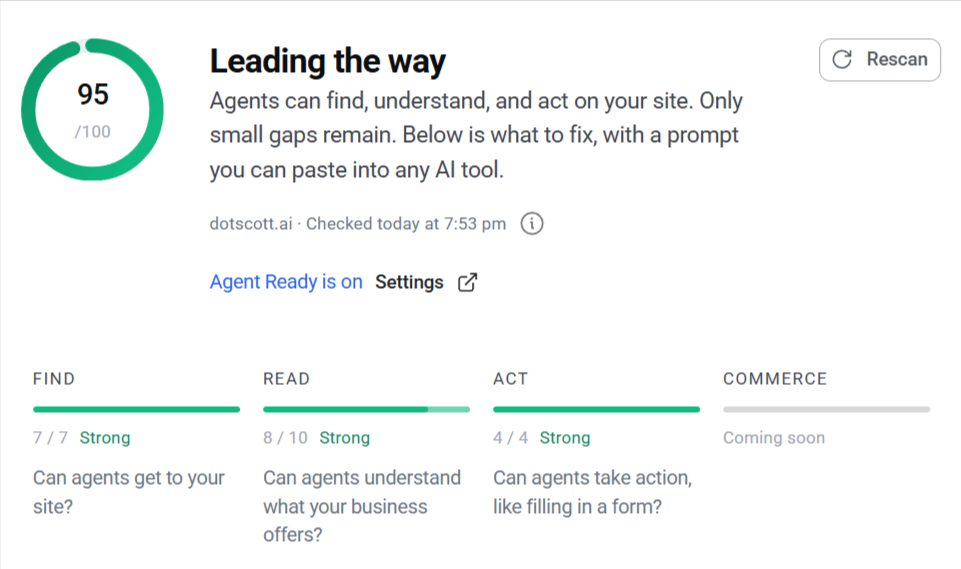
A readiness score. Elementor scans your site and gives it a score out of 100, broken down into Find, Read and Act. Every gap comes with a suggested fix. Some are a single switch, and others come as a ready-written prompt you can hand to an AI tool. A fourth area, Commerce, is marked as coming soon.
A set of switches, on a screen called Agent Access, that build the technical pieces from the content you already have:
- llms.txt: a short guide to your site that points AI tools to your most important pages.
- Markdown pages: clean text versions of your pages, with the menus, layout and scripts stripped out.
- Discovery files: standard files that tell agents what your site offers and where to find it.
- Bot access rules: your say over which AI bots may use your content, with separate choices for search, live answers and training AI models.
- WebMCP tools: four read-only tools that let compatible AI browsers look up your business details, search your site and read your pages accurately.
That bot access setting answers the worry we hear most often: “I don’t want AI taking my content.” Letting an AI read your site to answer a customer’s question, and letting an AI company train on your content, are separate decisions. You can say yes to one and no to the other.
We covered each tool in more detail when the beta came out, in Is your website ready for AI agents?
How dotscott.ai scores
We switched Agent Ready on for our own site first. The picture at the top of this article is our scan from 9 November 2026: 95 out of 100, with full marks for Find (7 of 7) and Act (4 of 4), and 8 of 10 for Read.
Getting there took more than flipping the switches. The remaining points came from work around them: describing every image, labelling our business details behind the scenes and making sure a missing page gives AI visitors a helpful message. We still have two Read items to finish, and we’ll be working through them.
What the score doesn’t tell you
Elementor is clear about this, and so are we: the score is a health check, not a measure of AI visibility. A high score means agents can find, read and use your site. It doesn’t promise that ChatGPT will recommend you, and it doesn’t guarantee extra traffic.
For that you need both halves. The technical foundations let AI in. Your content, reputation and consistency across the web give it a reason to choose you.
How DotScott can help
If your website is built with Elementor, we can update it safely, run the scan, switch on the right features, fix what the scan finds and show you the before and after. If it isn’t, we can still check how AI tools see your business and tell you what’s worth doing.
A good place to start is our mini AI visibility report, which looks at whether AI can reach your site, how clearly your business is described and what real customer-style searches turn up.
Call Scott on 07812 738833 or email scott@dotscott.ai.
DotScott: joining the dots on your web & AI journey.
Sources
- Elementor 4.4.0 changelog, WordPress.org, 9 November 2026
- Elementor Editor v4.4 release announcement, Elementor on GitHub
- How the web is changing for agents, and what agent ready means, Elementor blog